Signed in as:
filler@godaddy.com
Most tree problems in Colorado are diagnosed wrong before they are treated wrong. Drought stress gets treated as disease. Borer damage gets treated as fungus. We diagnose first, then treat only what is there.
Our founder holds a Colorado applicator license covering forested environments a credential few tree companies in the state carry which allows us to treat properties and situations other crews legally cannot.

Emerald ash borer is established along the Front Range and it does not spare untreated ash trees. Once a tree shows canopy thinning and D-shaped exit holes, the window has usually closed.
The decision is straightforward and it comes down to one question:
Is this ash tree worth protecting?
A mature, healthy, well-placed ash usually is and preventive treatment costs a fraction of removal and replacement. A replacement shade tree needs decades to catch up, while a declining or poorly sited ash usually does not.
We assess the tree, tell you honestly which category it falls in, and treat on a schedule appropriate to the product and the pressure in your area. We do not put ash trees on treatment plans that were never going to make it.
Bark beetles are a prevention problem, not a cure problem. Once beetles are under the bark of a pine or spruce, no spray reaches them the tree is lost and the priority shifts to removing it before it becomes a source for the trees around it.
Preventive trunk sprays applied ahead of the flight season protect a tree for that season. Timing is the whole game, and it moves year to year with elevation and weather. For properties in the foothills with significant pine or spruce, we build a rotation rather than reacting after the fact.
We also look at what made the tree attractive to beetles to begin with. Drought-stressed, crowded, and root-damaged trees get hit first.
Japanese beetles have become a fixture in the Denver metro area, and they concentrate on linden, crabapple, birch, roses, and Virginia creeper. Adults skeletonize leaves through midsummer; the grubs feed on turf roots.
Treating the adults on trees and shrubs is a timing exercise tied to emergence, and it usually takes more than one visit through the season. We are candid about what this does and does not accomplish: on a property surrounded by untreated lawns, we are managing damage, not eliminating the beetle.
Aspen are the most requested and most misunderstood tree in the Front Range. They evolved for high elevation and cool, moist soil, and most metro-area aspen are living somewhere they would not have chosen. That stress shows up as cytospora canker, marssonina leaf spot, ips beetle, and sudden decline in stands that looked fine last year.
We diagnose which of those is actually happening, they get confused for each other constantly, and tell you whether the stand can be managed, thinned, or should be replaced with something better suited to the site.
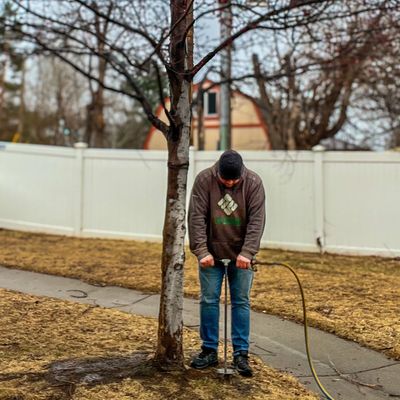
Fertilizer is not a cure, and we do not sell it as one. Front Range soils are alkaline, often compacted, and frequently short on the nutrient’s trees pull hardest. Where a soil test or the tree's symptoms point to a real deficiency, iron chlorosis in oaks and maples is the classic example, targeted deep-root fertilization helps.
Where the actual problem is water, compaction, or planting depth, we will tell you that instead save you the cost of feeding a tree that isn't hungry.
This is the least expensive and most neglected thing a Colorado property owner can do for their trees.
Front Range winters are dry, and the stretches between snowfalls leave root zones without moisture for weeks at a time. Trees are not dormant below ground the way they appear to be above it. The damage does not show up in January it shows up the following summer as dieback, thin canopies, and trees that suddenly cannot fight off the pests they had been handling fine.
Water on days above 40°F when the ground is not frozen, midday so it soaks in before dark, out at the drip line rather than against the trunk. Newly planted trees, evergreens, and anything installed in the last three years are the priority.